
The Ceiling America Cannot Build
The last essay said what is being built and why it is dangerous, and it held the constructive answer back. Here it is. What makes it devastating is that it is not available.

INVISIBLE FIST · JULY 2026
I · THE WITHHELD ANSWER
The answer that was withheld
An indictment is allowed to stop at the crime. The previous essay in this series, “A Paper Engine for a Physical War,” stopped there on purpose. It named the apparatus, a coordinated effort to fund roughly ten trillion dollars of rolling federal debt at a suppressed cost during a war, and it showed the flaw at the center: the act that makes the scheme succeed is the same act that pulls the ground out from under the market that has to hold it. It ended by pointing at the collision that would follow, the accord eating itself while a physical shortage sits there refusing to be printed away. It did not say what a serious country should do instead.
This is that essay, and the constructive answer turns out to be structural rather than tactical. There is no printer-side answer. Confronting a physical constraint requires a ceiling, meaning control over the inputs themselves and the processing that turns them into usable material, and a state whose enforcement tool is a printer cannot build one. Every floor-based attempt raises the price of the very input it is trying to secure, and gets captured on the way. The collision does not end in a detonation. It ends in relegation, with the privilege spent and the chain still in someone else’s hands.
The case for that conclusion is not an argument this file has to make. It is being made, in public, by the people running the apparatus, in sworn testimony, and by the tape.
II · THE PAPER LAYER
The instrument that cannot see its own cause of death
Start with the strongest available statement of the layer the accord actually operates on, because the argument is worth nothing if it beats a weak version.
In July 2026 the Berkeley economist Barry Eichengreen, together with Maxime Menuet and Gregory Donnat of the Université Côte d’Azur and GREDEG, released a working paper through the National Bureau of Economic Research titled “From Stocks to Flows: Debt Service and Fiscal Sustainability.” Using two centuries of American fiscal data from 1800 to 2023 and a long-run panel of twelve advanced economies, they find that what constrains a government is not the stock of its outstanding liabilities but the fiscal cost of servicing them. Primary surpluses track debt-service burdens. Debt ratios lose their explanatory power once service is accounted for.
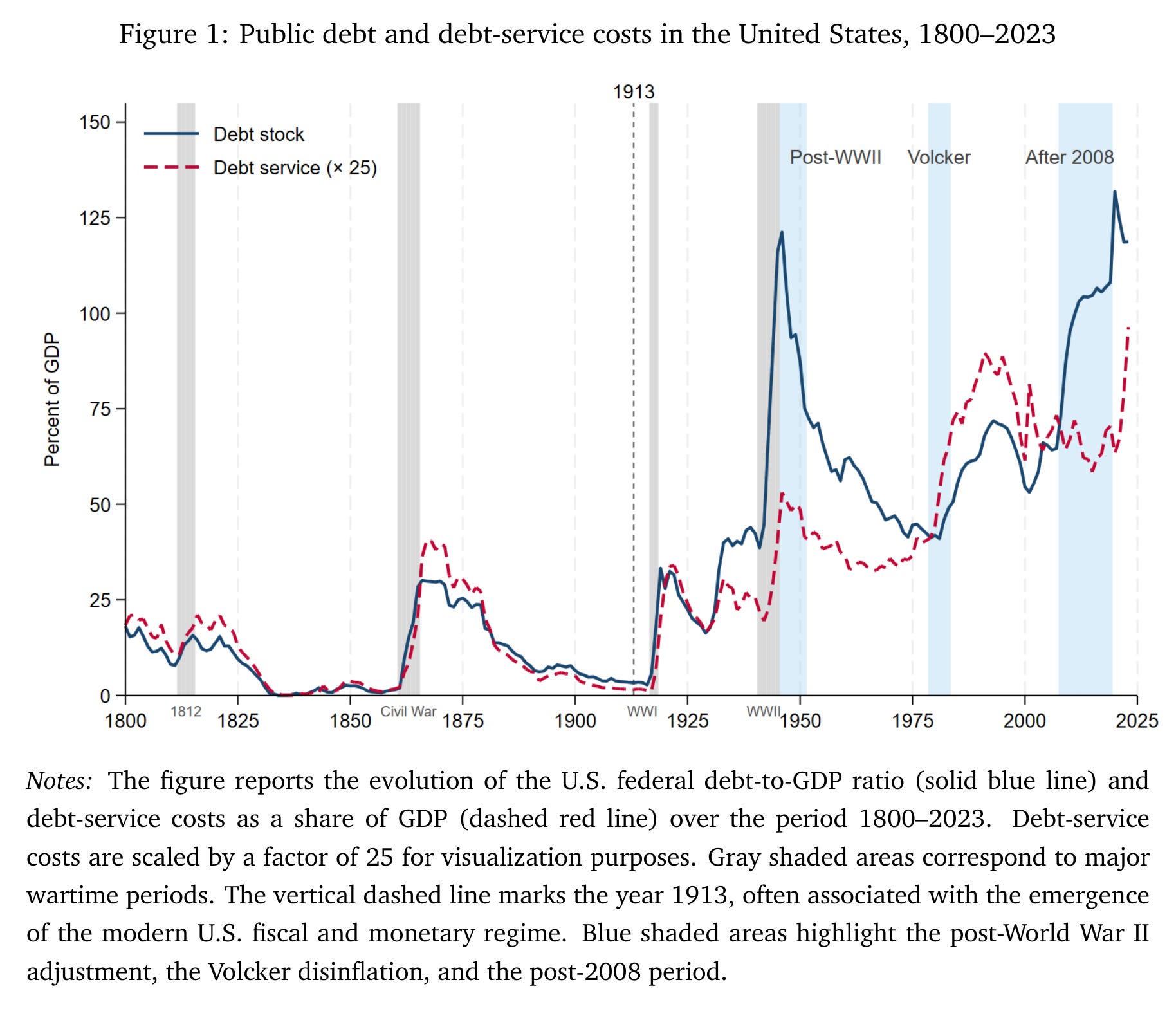
This is not a hostile document. It is the most rigorous version of the accord’s own premise. The whole apparatus exists to hold the cost of servicing the debt down, and here is a two-hundred-year dataset agreeing that servicing cost, not debt level, is the thing that binds. Read only that far and the architects look vindicated.
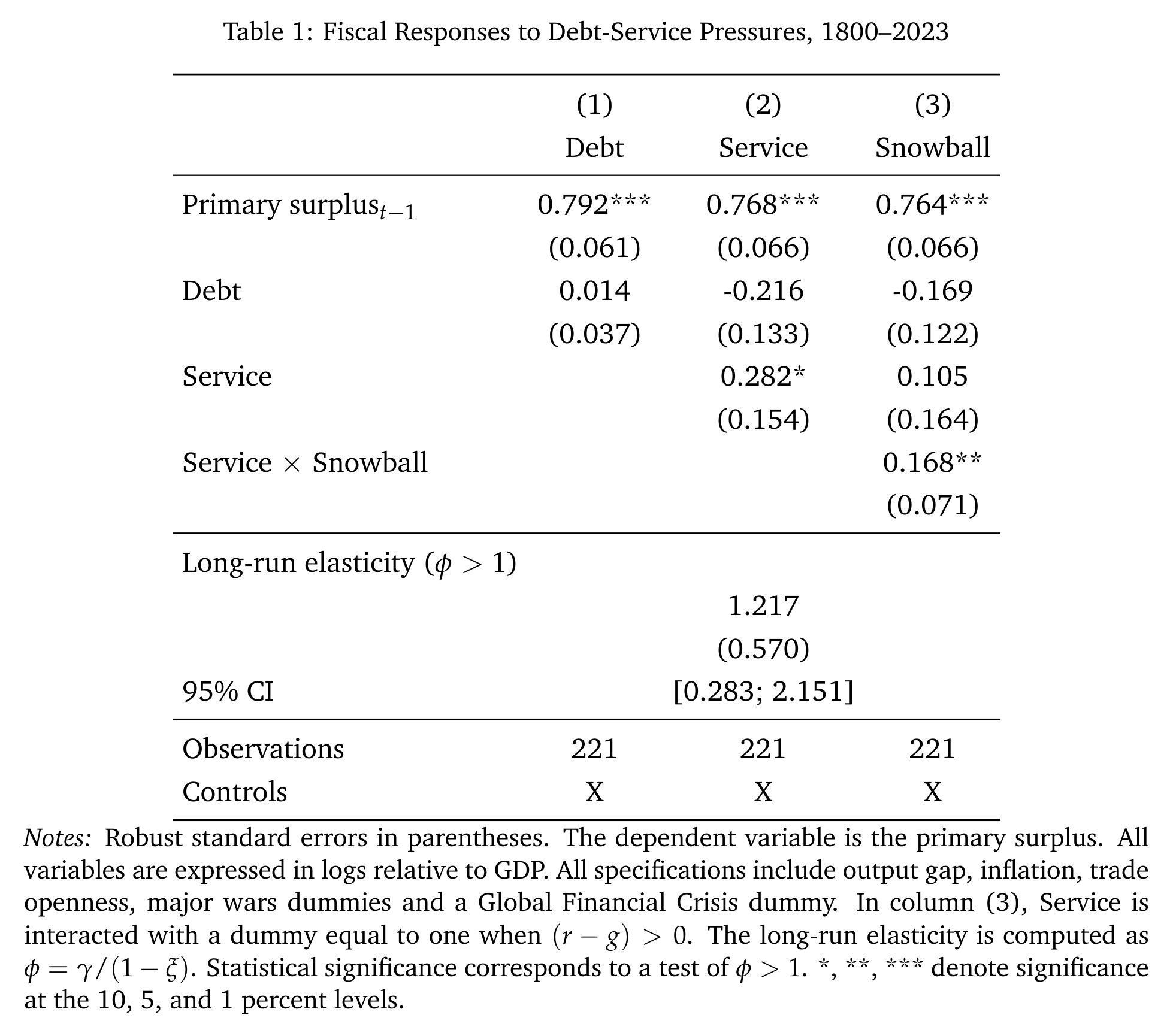
Read further and the paper describes the trap. Fiscal responses intensify when financing conditions deteriorate, specifically when the interest-growth differential turns positive. Their stability condition is explicit: when the real interest rate exceeds the growth rate, debt no longer stabilizes on its own, and holding the ratio steady requires fiscal adjustment strong enough to offset what the literature calls the snowball effect. The paper is a map of how much harder a government must work once financing turns against it.
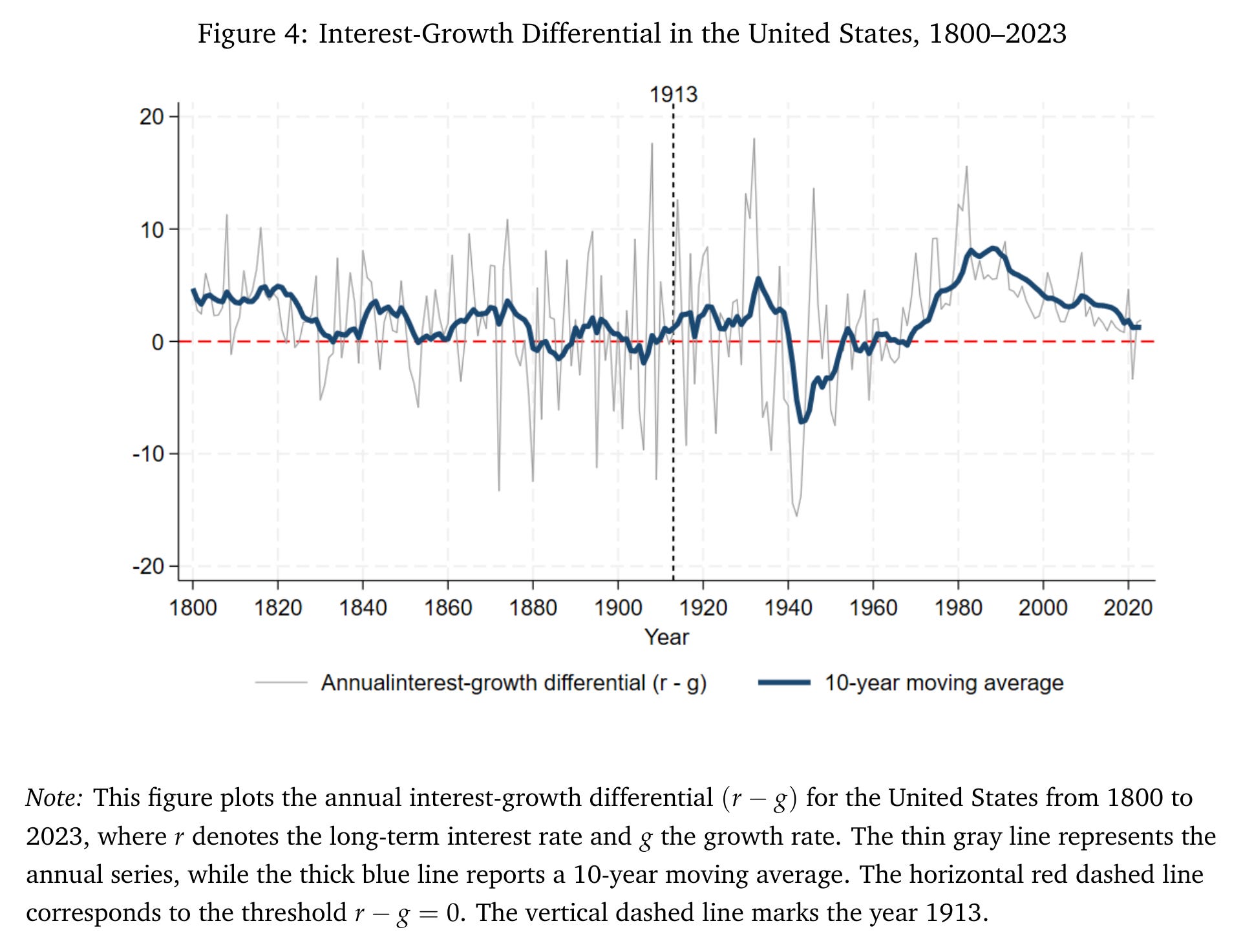
And now the omission, which is the entire point. In their framework the interest rate and the growth rate enter as long-run equilibrium values, treated as constants for tractability. There is no term anywhere in that model that can generate a physical-input shock. Nothing in it produces a closed strait, a refinery that will take five years to rebuild, or a refining monopoly on nineteen of twenty strategic minerals. The instrument measures the fiscal consequence with two centuries of precision and has no variable for the cause.
That matters because the physical shortage is exactly what forces the differential the paper says is decisive, and it forces it from both directions at once. The interest rate stays high because the energy-driven headline keeps the central bank restrictive, and growth falls because real demand is being destroyed underneath the same headline. One shock, both terms, moving the wrong way together. This is not a forecast. It is the reading this file published in June, in “The Cage, Part 2: The Chosen Door,” where the cross-asset tape showed the two-year yield jumping while the ten-year refused to follow and breakevens fell out of an oil shock rather than rising into it, because the market was pricing the demand destruction the committee’s own posture would cause.
The plumbing is already tightening, before the accord has shrunk anything. Scott Skyrm, who trades repo at Curvature Securities, counted three hundred and six billion dollars of net new Treasuries settling by the end of July and another hundred and thirty-seven billion in the first two weeks of August, four hundred and forty-three billion over thirty days draining the cash that funds everything else, and wrote that the soft funding should end pretty soon. As the Federal Reserve’s mortgage holdings have run off, he has watched the spread between mortgage collateral and general collateral widen from a trend near one and a half to roughly four. Jill Cetina, who led the bank-ratings team at Moody’s and served at the Dallas Federal Reserve and the Treasury’s Office of Financial Research, puts the floor for bank reserves at about three trillion dollars, which is where they already sit, and which is the level at which Silicon Valley Bank failed. She compares the shrink to landing a 757 on an aircraft carrier.
So the collision is not asserted here. It is measured, by an instrument with no term for what is killing it.
The clearest proof of that came from a member of Congress reading the Federal Reserve’s own charts back to its chair. In testimony before the House Financial Services Committee on July 14, Representative Sean Casten of Illinois turned to the Monetary Policy Report and noted that the chart of American consumer prices has inflation picking up on account of tariff policy, while the chart of global prices has it picking up again on account of foreign policy. The Fed’s own document localizes domestic inflation to a trade decision and international inflation to a war.
I don’t really understand the theory of the case that interest rates undo tariffs or that interest rates undo high oil prices.
REP. SEAN CASTEN (IL) · HOUSE FINANCIAL SERVICES COMMITTEE · JULY 14, 2026
Federal Reserve Chair Kevin Warsh conceded the first half, allowing that military conflicts overseas often affect prices in the short term, and then relocated his job to the second-round question of whether those prices spread. Casten’s closing observation was the one that lands: the committee did not vote on the tariffs or on the war.
III · THE GEOMETRY
Why the floor raises the fire
That a printer cannot reach the physical layer this series settled in “The Bailout Before the Bailout.” A floor lifts a claim and never separates a kilogram of oxide from its ore. The lender of last resort cannot be the refiner of last resort. The Sovereign Guarantee that essay traced is the geometry underneath everything here: the American tool is a floor that inflates claims, the Chinese tool is a ceiling that suppresses the cost of inputs, and they are not symmetric, because a buyer of last resort can only rescue what is printable and the input is not printable.
The narrower point this collision adds is worse than failure to reach. A floor does not sit inertly beside the shortage. It bids into it. Cheaper financing raises the present value of every claim written against a supply of real goods that cannot expand to match, which means the money aimed at securing an input arrives as demand for that input and lifts its price. The instrument meant to relieve the constraint is a bid on the constrained thing.
Two bidders are now in that same auction, and the size of the second one is new. Cetina points to Morgan Stanley’s estimate that the five largest artificial-intelligence hyperscalers will average roughly 1.1 trillion dollars a year of capital expenditure from 2026 through 2028, against a Defense Department budget of 961 billion dollars for fiscal 2026. The buildout outspends the Pentagon. Both are chasing the same copper, the same transformers, the same power, the same processed minerals, inside a war whose binding constraints are physical, and the financing layer is making both of them richer bidders rather than making the inputs more plentiful.
The chair’s own account of that buildout is where the blind spot becomes audible. In the same testimony, Warsh called it a supply shock in the United States, admitted it was happening faster than he would have projected two years ago, and said something like a hyper Moore’s law was underway. He described business investment as the most striking feature of the economy and said that what is now called AI investment will soon just be called investment. In an appearance running nearly three hours, he named the demand and the capital expenditure and never named an input. Not the helium, not the sulfur, not the copper, not the hydrofluoric acid, not the single Taiwanese chokepoint the whole thing routes through. The shock is described as though it arrives without a supply chain.
IV · THE CONFRONTATION
The confrontation is real, and it is floor-shaped
It would be dishonest to say the country is doing nothing about the physical layer. It is doing a great deal, and the shape of what it is doing is the argument.
The reporting is on the record. Elizabeth Dwoskin, Andrew Ba Tran, Luis Melgar and Peter Jamison of the Washington Post, working from PitchBook, USASpending and Pentagon releases, documented that funds linked to Donald Trump Jr. and Eric Trump hold positions in fifteen defense, robotics and artificial-intelligence firms whose portfolio has since generated at least 3.2 billion dollars of direct government business and 3.1 billion in future contract options, most of it after the second-term election. Vulcan Elements, a rare-earth magnet producer, received a 620-million-dollar Pentagon loan that the reporting describes as prioritized over other companies in line. The ethics counter belongs here rather than buried: the White House and the Pentagon deny preferential treatment, and ten of the fifteen firms held contracts before the investments, eight of them under the previous administration.
Then, on July 14, the war’s own settlement was converted into the same instrument. President Donald Trump announced on Truth Social that the Strait of Hormuz is open to all ship traffic except for Iran, that ships tied to Iranian ports or cargo face a full blockade, and that the twenty percent United States reimbursement fee would be replaced by trade and investment deals. The Wall Street Journal’s Brian Schwartz reported the reversal came after aides had spent the hours since Monday’s announcement trying to work out who would even collect the fee, with Secretary of State Marco Rubio having objected in June that no country may charge tolls on an international waterway. What the president described as the replacement was Gulf capital pouring factories, plants and equipment into the United States.
Read that as geometry rather than as scandal. A toll is a ceiling instrument. It prices access to a physical chokepoint, which is the one lever in the whole theater that touches the input directly. It was held for roughly a day and traded for inbound investment flows, which is a floor instrument, capital arriving to lift claims on American industrial assets. Offered the chance to hold a ceiling, the apparatus converted it into a floor within twenty-four hours, and routed it through the channel it already knew how to run. Whether those flows land with the patron class this file has tracked is a question the receipts do not yet answer, and it stays open. The caveat that belongs with it is that this president has contradicted his own Hormuz positions within hours before, so the reversal is current rather than settled.
The corruption is real and it is documented, but it is not the mechanism. The mechanism is that a state with only a floor will convert every ceiling it touches into a floor, because that is the tool its hand is shaped around.
V · THE TERMINUS
What the collision resolves into
Here is where the two halves meet, and the meeting is quieter than the word collision suggests.
The physical floor under input prices does not fall. The barrels, the refined metal and the processing capacity stay scarce on their own timeline, which the Bank for International Settlements measured in years rather than months and which no reserve release reached, since the largest in the International Energy Agency’s history covered twenty days of lost flow. Demand, meanwhile, collapses onto that floor, because the central bank stays restrictive against a headline the war keeps elevated. Prices do not spiral and they do not deflate. They sit on a floor the economy can no longer afford to pay, and the activity underneath thins out.
That is a vise, not an explosion, and this file has already named its resolution. “The Cage, Part 2” ended on the line that the physical layer wins in the end, and said that in April the only question was whether the central banks would understand that before the collateral cracked or after. That essay was answering for the Federal Reserve’s door choice, which failed by misdiagnosis. This one is answering for the accord, which fails differently, by disassembling the market that has to carry the paper while it is being carried. Two apparatuses, two failure modes, one terminus.
The chair has conceded the terminus in his own words, which is why this essay does not need to argue it. Pressed by Representative Ritchie Torres of New York on whether balance-sheet effects are comparable to rate effects, Warsh declined the word comparable and drew the distinction himself.
The balance sheet tends to work more through asset prices first.
KEVIN WARSH, CHAIR, FEDERAL RESERVE · SWORN TESTIMONY · JULY 14, 2026
That is the Federal Reserve chair, under oath, separating the paper channel from the real economy. He went further in the same exchange. Torres noted that the balance sheet grew roughly fivefold between 2008 and 2014, from about nine hundred billion dollars to four and a half trillion, while core inflation averaged 1.5 percent, below target, and Warsh agreed that quantitative easing is not inherently inflationary. The tool moves the price of paper. It has been demonstrated, by its own operator, not to reliably reach the price of things.
What follows from that is relegation and not implosion, and the distinction is worth defending. An implosion is an event with a date, and this file does not have one and will not manufacture one. Relegation is a condition. The privilege gets spent, the reserve function erodes at the edges rather than collapsing at the center, and the country arrives on the other side of the war still solvent, still issuing, still important, and no longer setting the terms. The Bank of England’s deputy governor, Clare Lombardelli, has already put the first half of that on the record, describing the erosion of the exorbitant privilege and global imbalances near hundred-and-fifty-year highs.
The honest boundary belongs here. The direction is over-determined, with two rival mechanisms, the shortage that will not decay and the demand destruction underneath it, both forcing the same differential. The magnitude is not settled, and this essay holds relegation as the more likely pole rather than a verdict. Anyone claiming the date is selling something.
VI · THE ANSWER
The answer that will not come
So what would work?
A ceiling. Not a subsidy for a mine, not a price support, not an equity stake, not a guaranteed offtake, all of which are floors wearing industrial-policy clothing. A ceiling means holding the input and the processing such that the cost of the material can be set rather than bid for. It is what China built, through investment and policy rather than geology, and it is why refining nineteen of twenty strategic minerals converts directly into the power to move prices by moving supply. The United States is fully import-dependent on seven strategic minerals and permits a new mine on an average timeline of twenty-nine years. Twenty-nine years is not a financing problem. It is longer than the war, longer than the administration, and longer than the bond it would be financed with.
At which point the obvious escape hatch opens, and it deserves to be taken seriously because serious people are walking through it. If the dollar system is the thing that traps the country in floor-shaped answers, then leave the dollar system. Settle in gold. Settle in bitcoin. Complete the chartalist argument and end the international dollar arrangement, as the independent monetary theorist Clint Ballinger has proposed. Restore a denominator that cannot be printed, and the discipline returns.
It does not work, and the reason is the same reason nothing else on the printer side works. Global demand for rare earths, for inelastic materials, for skilled labor and for energy cannot be purchased by reserve metals or by bitcoin at any price either. The physical wall binds regardless of the denominating asset. A hard-money settlement system changes who is embarrassed by the constraint and changes nothing about the constraint. The reserve-currency problem is not an American problem that a better American currency would solve; it is what every developed economy is now discovering at once, which is why the long bonds of six developed nations sold off in a single session this July. Dedollarization relocates the question. It does not answer it.
That is the whole shape of it. The confrontation requires a ceiling. A ceiling requires the chain. The chain is held by the adversary, and no denominating asset, no accord, no task force and no press buys it back inside the clock. The apparatus described in the last essay is not a bad answer to the physical war. It is a fluent answer to a different war, executed by people who are not fools, using the only instrument their state knows how to hold, aimed one layer above the fire.
The chair said it himself, and he was talking about the balance sheet when he said it. It works through asset prices first.
INVISIBLE FIST · ARCHITECTURE OF CRISIS
VISIBLEFIST.SUBSTACK.COM