
The Deflation Machine, Report No. 4
THE MONTH THE LABOR MARKET STOPPED HIDING THE DEFLATION

INVISIBLE FIST • RECEIPTS THROUGH AUGUST 7
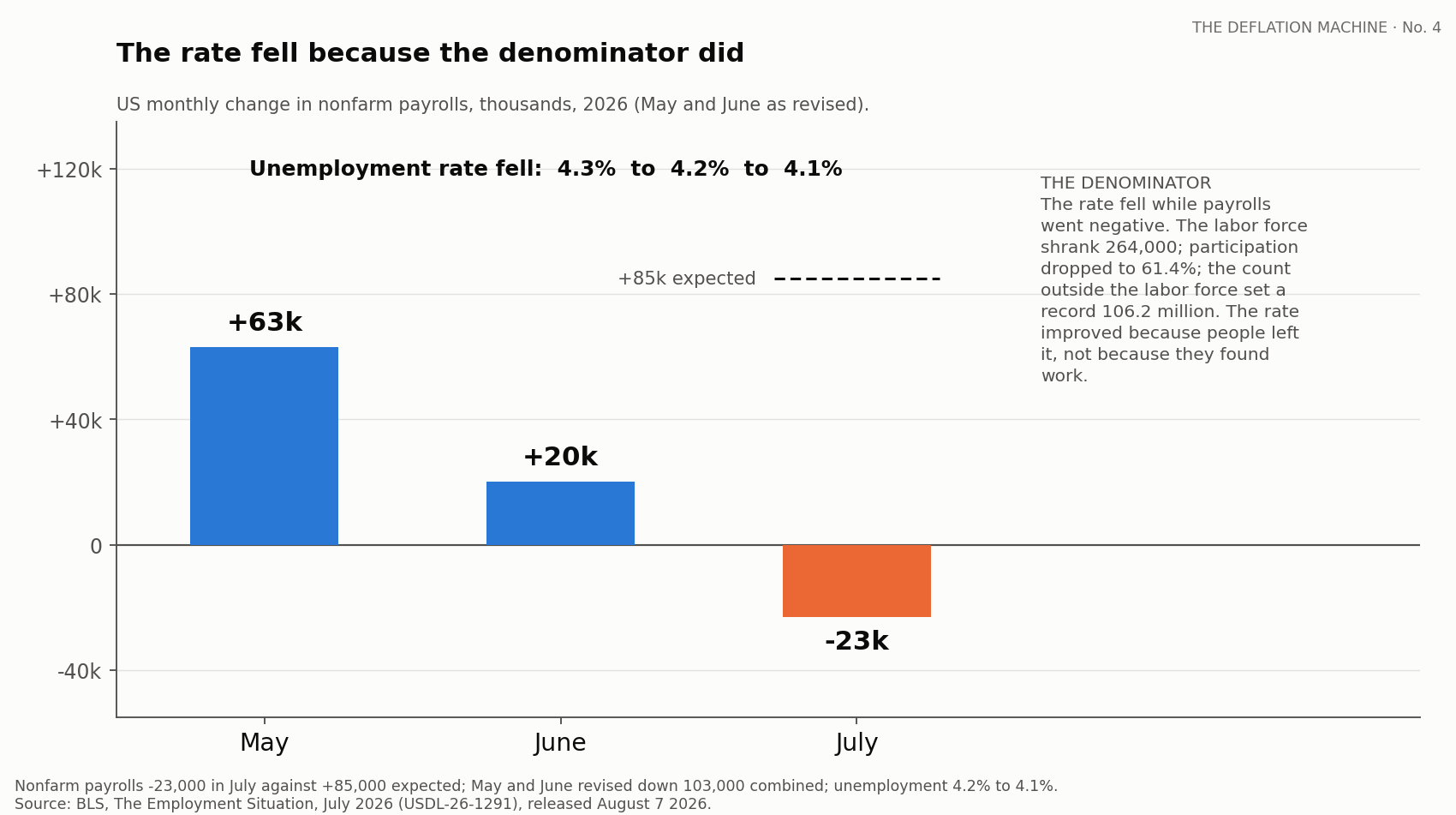
On Friday the Bureau of Labor Statistics said American employers cut 23,000 jobs in July, and that the unemployment rate went down.
That’s not an error. Payrolls printed negative for the first time in years, May and June got revised away by 103,000 between them, and the jobless rate still slipped to 4.1 percent from 4.2. That is not a typo and it is not a paradox. The rate fell because the people who lost the jobs stopped looking for new ones, and the moment you stop looking the survey stops counting you. The labor force shrank by 264,000. The ranks of Americans neither working nor looking for swelled by 381,000, to a record 106.2 million. It improved by shoving them out the back door.
Four reports in, this report has traced the mechanics under that number. Intelligence gets cheaper, the companies that buy it pocket the difference, and the cost of the automation has to land on somebody. This month it landed in the one labor number Washington cannot dress up, and the official series quit hiding
“I was literally digging my own grave.”
GEOFF MCGEHEE, LAID OFF FROM A CUSTOMER-RELATIONSHIP JOB AT SEARS HOME SERVICES AFTER HELPING ROLL THE AI IN
I. THE PRICE OF THE THING ITSELF
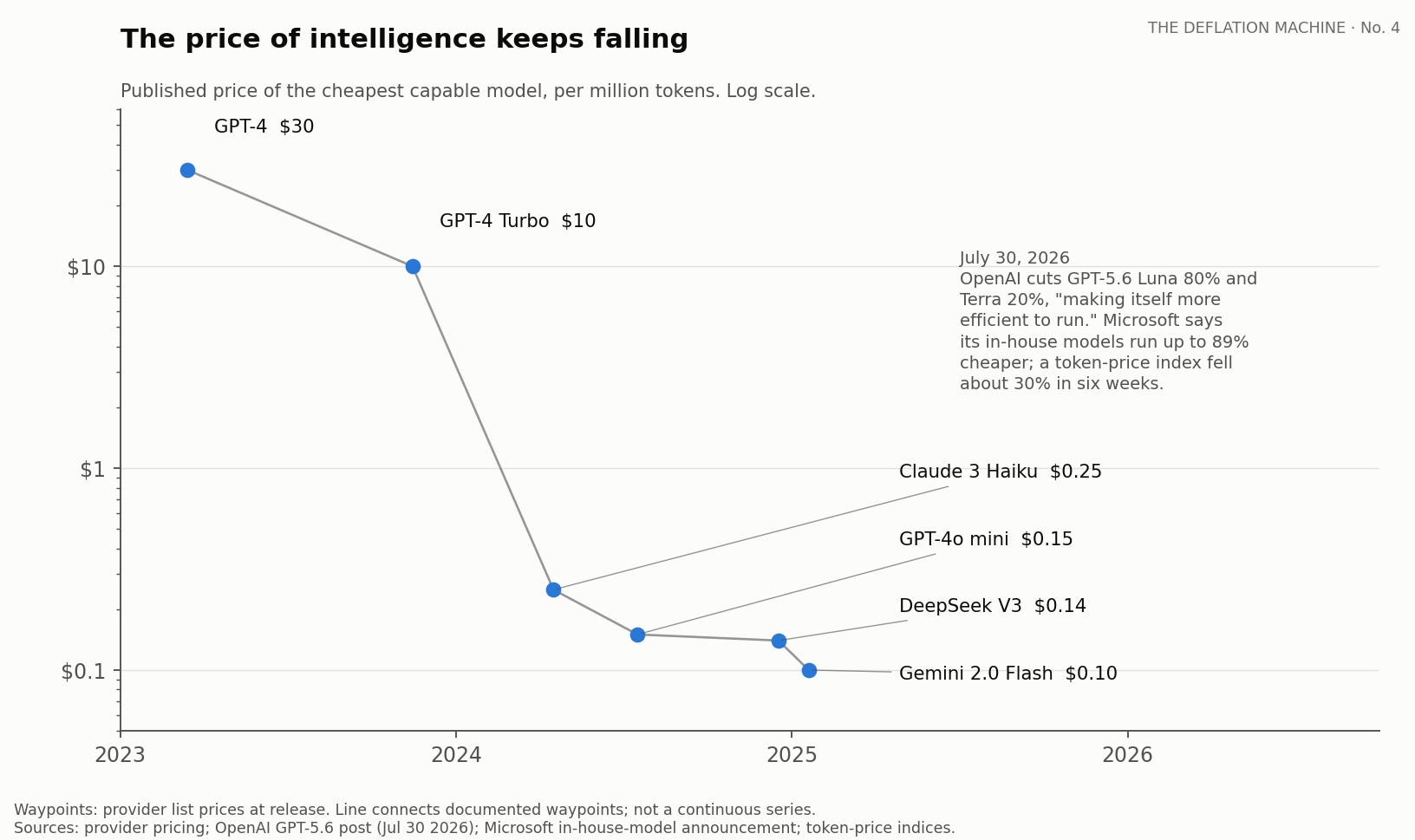
On July 30 OpenAI cut the price of intelligence in the open and told everyone why. It dropped its GPT-5.6 Luna model by 80 percent and its Terra model by 20 percent, and skipped the usual press-release fog. “We applied GPT-5.6 Sol to advance the frontier of efficiency by making itself more efficient to run,” the company wrote, “passing those gains on in the API with lower prices for Luna and Terra.” They pointed the model at the cost of running the model, and handed the buyer the change. On one tool, auto-review, they told customers to “expect Auto-review to cost about 10x less.”
Call it the flywheel this file keeps describing, now spelled out by the one party with every reason to keep quiet about it. And it is not a one-off. Microsoft says its in-house models run its own AI features up to 89 percent cheaper than the outside frontier model it used to rent. A closely watched index of token prices fell about 30 percent in the six weeks into the end of July. Nobody selling the stuff argues with the direction anymore. Intelligence gets cheaper every quarter, and every cut drops into somebody else’s cost stack as an input.
II. THE ADOPTERS BOOK THE SAVING
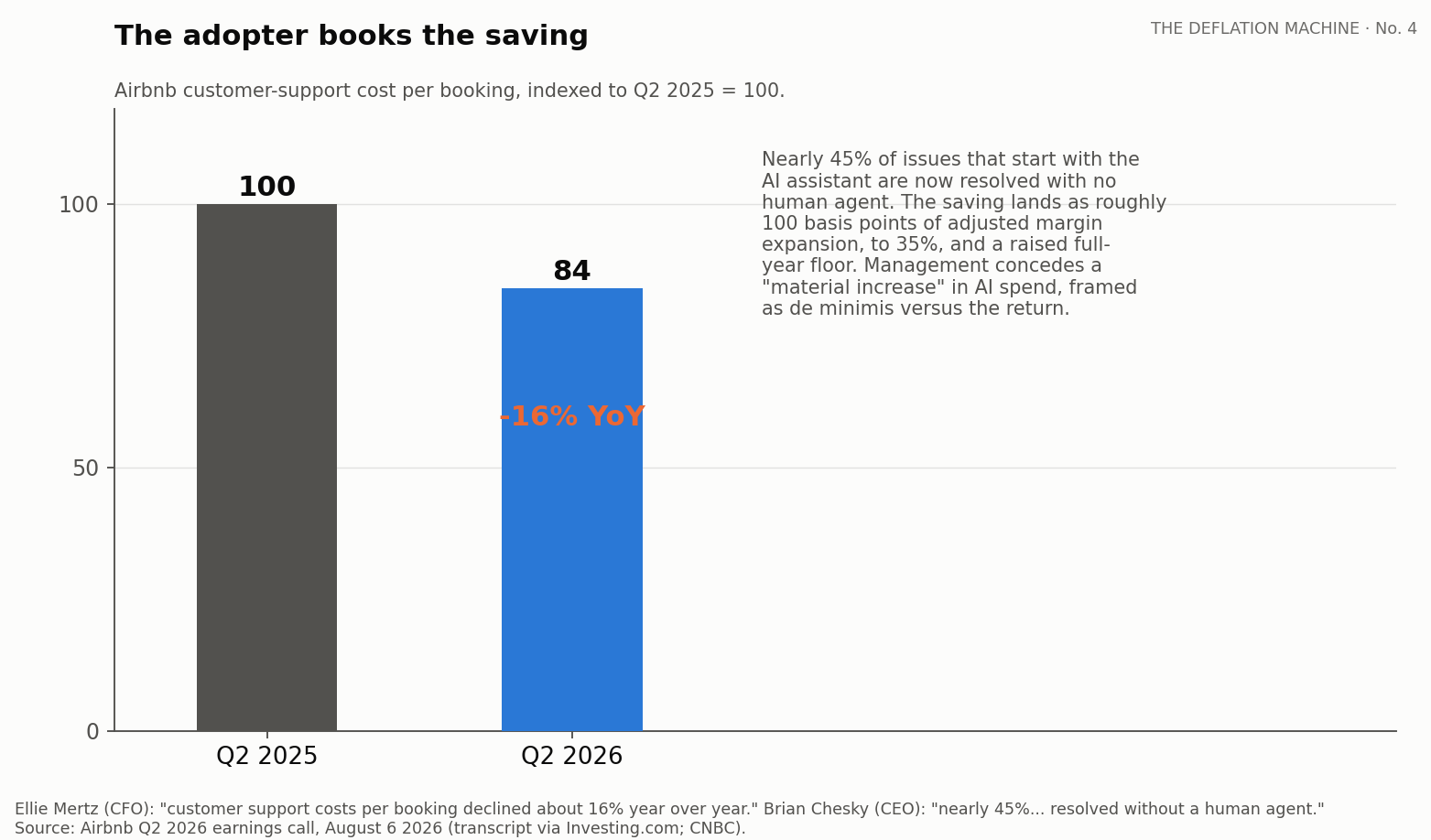
Follow that price down into a customer’s books and you land on Airbnb. On its second-quarter call this week the company finally put a number on what the first report could only point at. Ellie Mertz, the chief financial officer, told analysts that “customer support costs per booking declined about 16% year-over-year.” Brian Chesky, the chief executive, gave the how: “Nearly 45% of issues that start with our AI assistant are now resolved without a human agent.” Almost half of Airbnb’s support tickets now close with nobody on the other end, and the cost of handling each booking dropped by a sixth.
The saving went straight to the margin. Adjusted margin widened about a point and the company lifted its full-year floor. Our standing rule says no saving counts until the same company names the spend against it, and Airbnb named it in the same breath: the guidance “does assume a material increase in terms of the AI spend over the course of the year,” with inference waved off as “de minimis relative to the ROI of our business model.” So the clawback is real, the dollar figure is missing, and the net still shows up as margin. Twilio told the quieter version from the vendor seat, its chief executive pointing to a customer whose AI agent fielded nearly 300,000 conversations, its revenue chief to another customer’s shrinking “cost to serve,” no number attached. Same story underneath. The human on the phone is the unit getting removed.
III. THE METER ON THE LABOR LINE
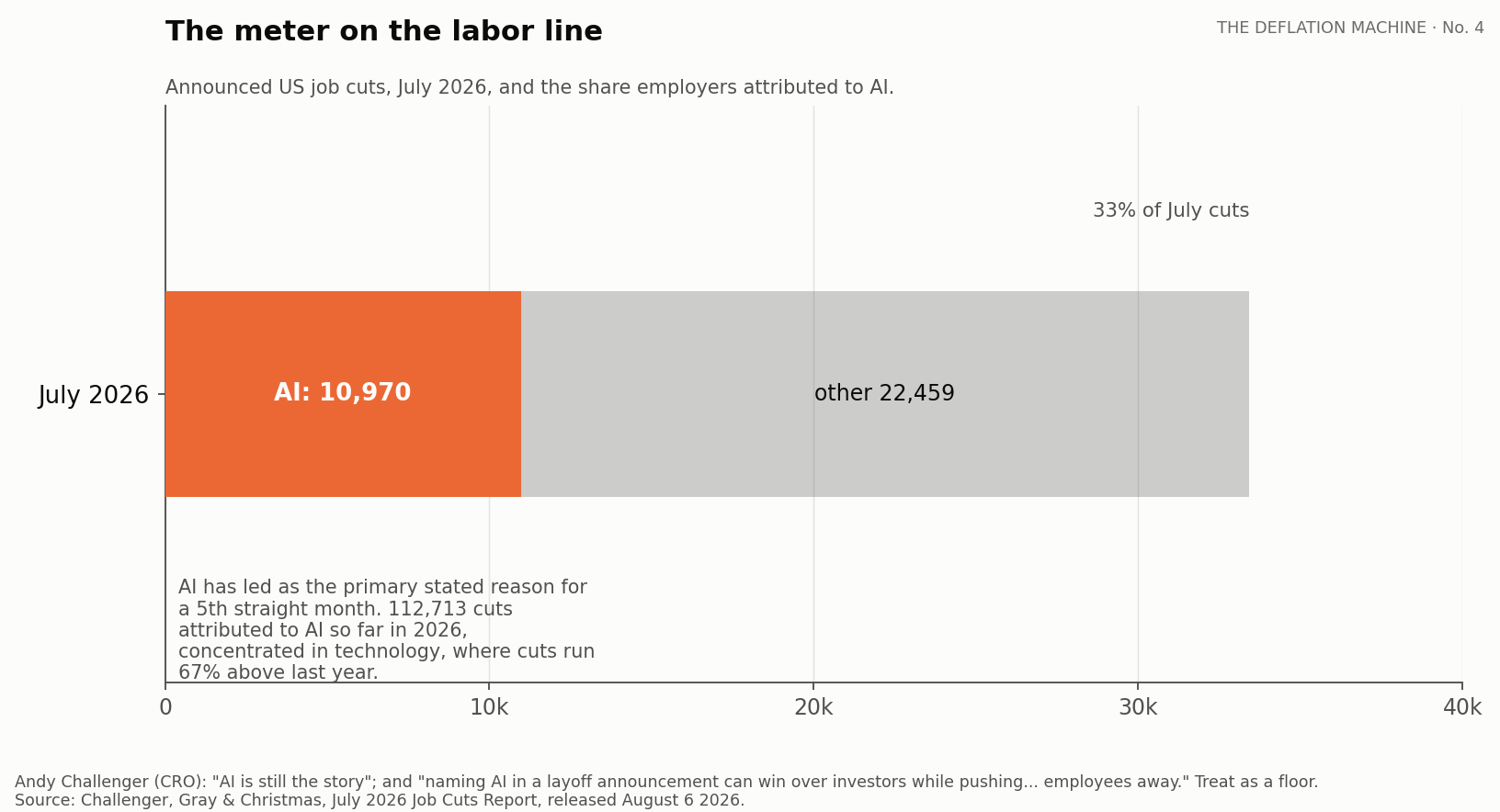
Those removed contacts pile up somewhere, and once a month the Challenger firm counts the pile. Employers announced 33,429 job cuts in July. Challenger pinned 10,970 of them on artificial intelligence, a third of the month, the fifth month straight that AI topped the list of stated reasons. Year to date the AI tally hit 112,713, bunched in technology, where the cuts run 67 percent hotter than last year. Of every running gauge on the labor ledger, this is the cleanest, and the needle has pointed one way since spring.
The firm doing the counting attaches a warning, and it is worth printing whole. “AI is still the story, as investments in the technology reshape organizations,” said Andy Challenger, the chief revenue officer. Then the tell: “Naming AI in a layoff announcement can win over investors while pushing current and prospective employees away.” The reason code is bought and paid for. A company that blames AI for a layoff is not talking to the worker it cut, it is talking to its shareholders, and the same word that erased the job goosed the stock. Report No. 3 built its whole spine on that trade. Here it is again, stamped on a pink slip. Take the count as a floor and a signal. Not proof.
IV. THE DENOMINATOR
Announcements are intentions. Friday brought the realized number, and it stopped hiding. Payrolls fell 23,000 against a Street that had penciled in a gain of 85,000, and the two prior months bled 103,000 in revisions, which drags the three-month run rate of hiring down to 20,000. The mix underneath tells it better than the headline. The two crutches Bloomberg’s economists had named a week early both snapped on cue: the temporary World Cup hiring rolled off, pulling leisure and hospitality down 40,000, and the state and local budgets that were supposed to catch the fall did not, with local government education down 50,000. Financial activities shed another 14,000 and now sit 121,000 below their peak of fifteen months back. Health care added 22,000 and just about carried the whole report on its back.
Now the rate. It dropped to 4.1 percent, and it dropped for the exact reason Report No. 2 laid out in July. Participation slid to 61.4 percent, down seven tenths since January. The share of adults actually holding a job fell to 58.9 percent. The headcount of people neither working nor looking hit a record. It got better because the denominator drained, not because anyone found work, and this time the Bureau of Labor Statistics printed the mechanism this file has asserted for three straight reports. Circle August 28. The annual benchmark revision lands that day, it runs off tax records, and it points down.
V. THE GROUND
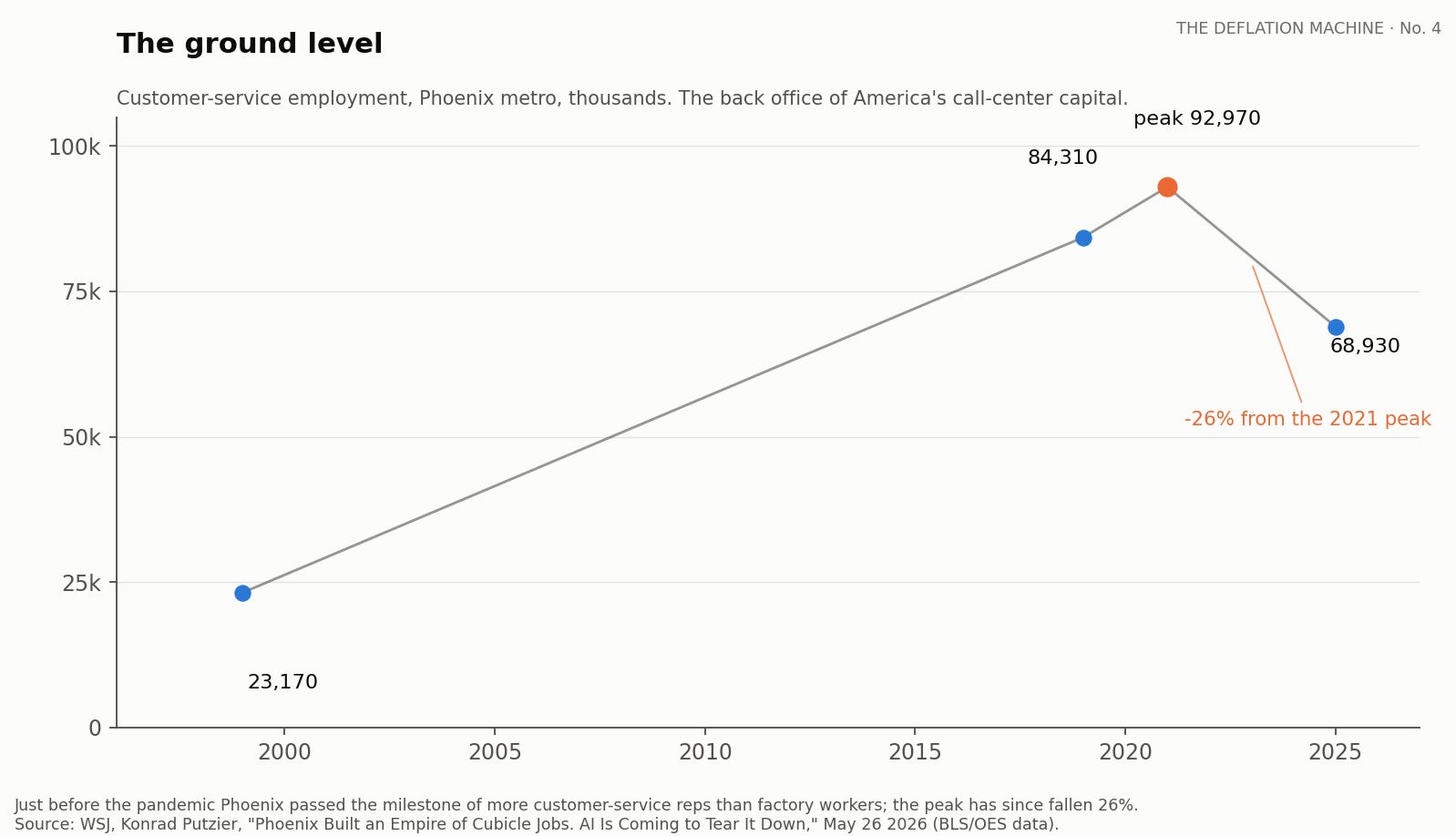
Numbers this high up lose the person underneath them. A Wall Street Journal feature in May went and found one. It walked the wreckage of the back-office economy in Phoenix, the country’s call-center capital, where the customer-service workforce has dropped from 92,970 in 2021 to 68,930 in 2025 and where developers now knock down the emptied call centers to pour data centers on the lots. The reporter tracked down Geoff McGehee, cut loose from a customer-relationship job at Sears Home Services after he helped wire the AI in. “I was literally digging my own grave,” he said. Nationwide the Labor Department counts about 16.5 million people in office and administrative-support jobs, down from roughly 18 million at the end of 2019, and pencils in the steepest drop of any major category over the next eight years.
Keep a second engine in the frame here, because AI is not the only thing gutting these jobs. Offshoring is doing it too, and faster by the raw count. Since 2019 the big multinationals have grown their offshore payroll 36 percent, north of eight million jobs, against 17 percent at home. The cubicle economy that once caught the workers the factory spat out is now getting bled from both ends at once. The aggregate stands on that ground. It does not turn a laid-off claims adjuster into a chip-fab technician.
VI. THE HONEST COUNT
The case has a real rebuttal and this file keeps it at full strength. In July, Peter McCrory of Anthropic’s economics team put out a synthesis arguing AI has not lifted unemployment, that the labor market is holding at 4.2 percent, that so far the technology sharpens human expertise on a jagged frontier instead of replacing it. This week’s earnings back him up in a spot the thesis did not expect. Gartner, the research shop the displacement story had marked for commoditization, instead sped up, raised its guidance, and told investors AI is “the single biggest driver of demand” for its advice. Some incumbents are selling more precisely because everyone is confused and will pay to be un-confused.
So the situation cuts both ways, and here it is straight. The Bureau of Labor Statistics blames none of Friday’s losses on AI, and it never will. The line from a cheaper token to a cut job is an inference that we argue, not a number the government will advertise. One negative payroll print is noise until it is a trend, and revisions swing both ways. What moved this month is the weight of it. The frontier labs cut the price out loud, an adopter booked the savings with a figure attached, the layoff meter has led with AI five months running, and the official jobs number quit flattering itself. The economy is cracking first exactly where the machine said it would, among the young, the entry-level, the back office, the marginal hire, while the top-line rate holds a while longer. For now.
The unemployment rate fell in July. It fell because the workers stayed home.