
The Net Pointed at the Ceiling
The post-2008 financial architecture built a safety net so reassuring that nobody checked which direction it catches.

Blade 20 of the Rorschach Layer
In a Soviet glass factory, the story goes, the production targets were set in tons. The workers met their quota by making panes so thick you could not see through them. The glass was real. The factory was real. The quota was met. And nobody could look outside.
What the Net Is
On October 31, 2013, the Federal Reserve and five other central banks (the Bank of Canada, the Bank of England, the Bank of Japan, the European Central Bank, and the Swiss National Bank) converted their temporary bilateral swap arrangements into standing facilities. The announcement’s language is precise and public: the arrangements “allow for the provision of liquidity in each jurisdiction in any of the five currencies foreign to that jurisdiction.” Six central banks, five currencies each, any direction, permanent, no expiration.
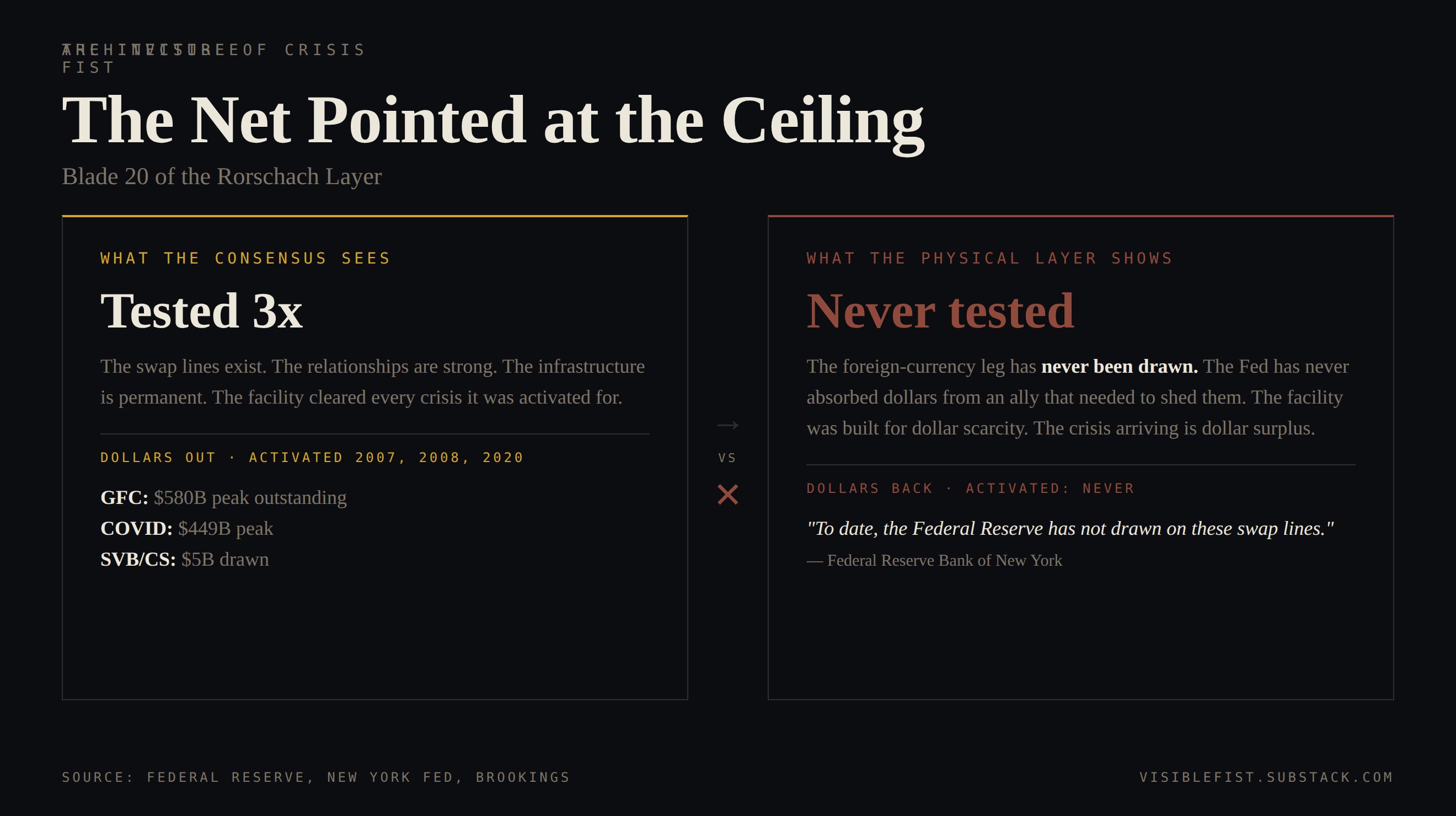
The facility works mechanically: a foreign central bank that needs dollars exchanges its own currency for dollars with the Fed, lends the dollars downstream to its domestic banks, and reverses the swap at a set date at the original exchange rate plus interest. The Fed bears no exchange rate risk and is not a counterparty to the downstream loans. It is a clean, elegant, crisis-tested piece of infrastructure, and it has been activated three times in living memory: in the global financial crisis, in the European sovereign crisis, and in the first weeks of the pandemic. Each time it worked. Each time it worked by sending dollars out.
Now the fact the market does not hold, stated in the Fed’s own disclosure and available on the New York Fed’s website to anyone who looks: to date, the Federal Reserve has not drawn on the foreign-currency side of these swap lines. Not once. Not in the financial crisis. Not in the pandemic. Not in any of the stress events of the past seventeen years. The facility is technically bidirectional. It has been operationally one-directional for its entire existence.
What the Consensus Sees
The consensus sees exactly what the architecture was designed to show: resilience. The swap lines exist. The relationships are strong. The infrastructure is permanent. If Japan needs dollars, the BOJ calls the Fed and the dollars arrive. If Europe needs dollars, the ECB calls and the dollars arrive. The facility was tested three times and cleared every test, and a system that has cleared three tests is a system a risk model rewards you for trusting.
This reading is not wrong about the past. It is wrong about the direction.
What the Physical Layer Shows
Every crisis the swap lines have solved was a dollar-shortage crisis. Counterparties needed dollars and could not get them in the market. The facility supplied dollars against foreign currency at a penalty rate, the foreign banks rolled their dollar funding, and the crisis resolved. The mechanism is superb at what it does, and what it does is cure a shortage of the thing the Fed manufactures.
But now imagine the crisis that is not a dollar shortage. Imagine instead a critical ally, Japan being the concrete case since the yen sits at multi-decade lows, that holds the world’s largest single-country stock of US Treasuries and needs not to acquire dollars but to convert them. An energy shock, denominated in a currency that is not the dollar, or in a commodity whose sellers have begun pricing outside the dollar system, or simply in the physical fact that the island imports virtually all of its fuel and the fuel has become scarce. The ally needs yen. Or it needs euros. Or it needs the commodity itself. What it does not need is more dollars.
Run that crisis through the swap facility and the door opens from the wrong side. The standing swap line lets the BOJ borrow dollars from the Fed. It does not let the BOJ lend dollars to the Fed in exchange for the thing it actually needs. The foreign-currency leg, the one that would let the Fed draw yen and send them to the BOJ, exists on paper and has never been activated. Not because it was refused, but because the crisis that would activate it has never arrived. The facility was built for a world in which the dollar is the thing everyone scrambles to get. The world arriving is one in which a critical ally may scramble to shed dollars, and the net does not catch that fall.
This is not a design flaw. It is a design assumption, and the assumption is that dollar demand is always the binding constraint. The Rorschach is in the assumption: as long as it holds, the facility is a masterpiece of crisis architecture. The moment it stops holding, the facility is a fire station whose trucks only turn left.
The Rorschach Structure
State it in the blade’s native format, because the structure is pure.
The same object, the standing swap line network, produces two readings. One reading says: the system is robust, because the tool exists, has been tested, and cleared. The other says: the system is fragile, because the tool is directional, has been tested only in one direction, and the direction it has not been tested in is the one the physical layer is now delivering.
The comfortable reading propagates, because “the Fed has swap lines with five major central banks” fits in a headline and in a risk model and in a Congressional testimony. “The swap lines are a one-way valve built for a crisis that is not the crisis arriving” does not fit in any of those, because it requires the listener to hold two thoughts at once: that the infrastructure is real and that the capability is not.
That is the Rorschach exactly. The blot shows a safety net, and the observer who reports safety is not lying. He is looking at a real net. He is simply not asking which direction it faces.
The Political Layer
Beneath the directional problem sits a second one, and Brookings named it in August 2025 before anyone was asking the question under fire. Foreign central bankers have begun asking whether a post-Powell Federal Reserve will be as willing to lend dollars as the pre-Powell and Powell-era Fed were. The standing swap lines are standing in the legal sense: they have no expiration and require no renewal. But they are discretionary in the operational sense: the two central banks in a particular arrangement must “judge that market conditions warrant” activation. That judgment is made by human beings with political constraints, and the political constraints have changed.
So the one-directional net is also a conditionally one-directional net. The direction it works in, dollars out, is the direction a future Fed might hesitate to operate in, because sending dollars to foreign central banks during a crisis is a political act that a domestically focused administration may read as bailing out foreigners. And the direction it has never worked in, dollars back, is the direction nobody has ever asked the facility to operate, so there is no institutional muscle memory and no tested protocol for a Fed that absorbs a flood of returning dollars from an ally that needs to sell them.
The net exists. The relationships exist. The infrastructure is permanent. And none of that answers the question the physical layer is asking, which is not “can you lend me dollars” but “can you take them back.”
What Would Falsify This Blade
Three conditions, each checkable.
The blade is wrong if the foreign-currency leg of the swap lines is activated and clears. If the Fed draws yen or euros from a counterparty central bank at scale and the facility performs, then the one-way-valve claim fails on its own terms. Watch for this: it would be the single most important operational test of the post-2008 architecture, and it would settle the blade instantly.
The blade is wrong if a dollar-surplus crisis arrives and is resolved by a mechanism outside the swap lines: coordinated intervention, by bilateral Treasury operations, by a new facility purpose-built for the reverse flow. The swap lines being one-directional does not mean the system has no other tools; it means this tool, the one the consensus points to, does not do the job the consensus assumes it does.
The blade is wrong if the dollar-surplus crisis never arrives, if the physical layer’s constraints resolve without forcing any ally to shed dollar reserves at speed. In that case the valve’s directionality is a theoretical curiosity and the comfortable reading was correct all along: the net existed, it faced the right way, and nobody ever fell from the other side.
The blade registers all three and watches for the first.
Blade 20 of the Rorschach Layer. The standing swap arrangements were made permanent on October 31, 2013, by joint announcement of the six participating central banks. The Federal Reserve’s own disclosure that it has never drawn on the foreign-currency leg is published on the New York Fed’s markets page. The Soviet glass factory is an old parable about the difference between meeting a metric and serving its purpose.
VISIBLEFIST.SUBSTACK.COM