The Structural Short
ARCHITECTURE OF CRISIS

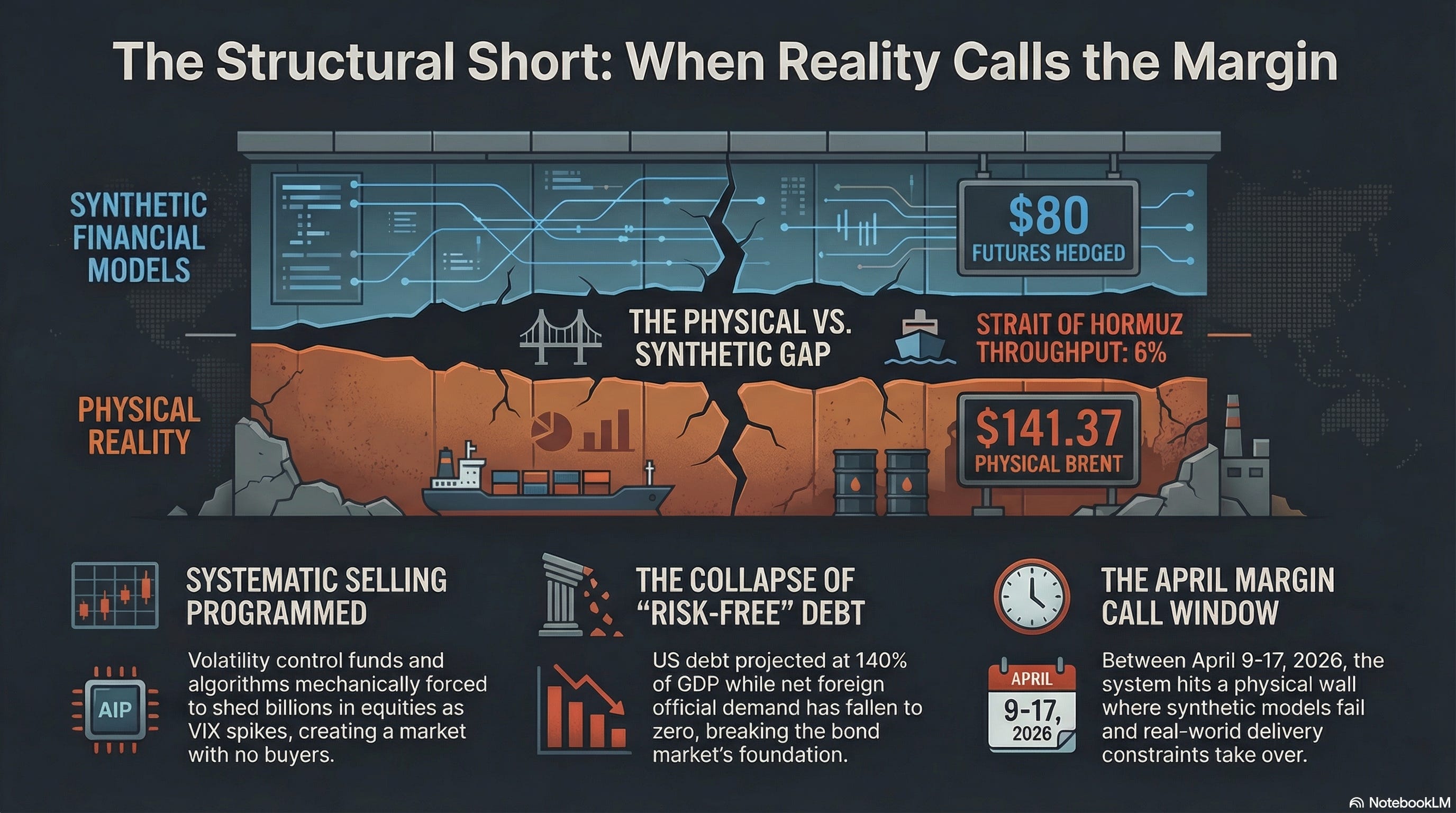
Short Everything Real, Long Everything Synthetic
April 2026 • Invisible Publication • visiblefist.substack.com
The global financial system is running a single unified trade. It is short commodities, short volatility, and short bonds. These are not independent positions taken by independent actors for independent reasons. They are the load-bearing walls of an architecture that assumed three things would remain true indefinitely: supply chains are resilient, central banks will intervene, and sovereign credit is unquestionable.
All three assumptions share a single point of failure: a physical disruption large enough to invalidate the premise that the synthetic layer accurately prices the real one.
That disruption has now arrived.
• • •
SECTION I
The Circle
Before the disruption, the architecture was self-reinforcing. Each assumption supported the others, and each market existed in a state of equilibrium that felt permanent because it had persisted for so long.
Low commodity prices kept inflation subdued, which allowed central banks to remain accommodative, which kept interest rates low, which made sovereign deficits financeable at manageable costs, which supported the dollar as the global reserve currency, which allowed commodities to be priced in dollars, which kept commodity prices low. The circle fed itself.
Low volatility kept leverage manageable across the financial system, which kept the basis trade profitable for hedge funds borrowing short-term to own long-term Treasuries, which provided liquidity to the Treasury market, which kept auction demand healthy, which kept yields stable, which kept volatility low. Another circle.
Low bond yields kept collateral values high, which kept the rehypothecation chains functioning, which allowed dealers to intermediate the repo market, which kept the plumbing operational, which allowed the Federal Reserve to manage the system through small adjustments to the overnight rate rather than emergency interventions. A third circle.
These three circles interlocked. Cheap commodities enabled accommodative monetary policy. Accommodative monetary policy suppressed volatility. Suppressed volatility preserved collateral values. High collateral values funded the deficit. The funded deficit supported the military that kept the sea lanes open. Open sea lanes kept commodities cheap.
The system was not designed. It emerged. And because it emerged rather than being designed, no one was responsible for stress-testing the assumption at its center: that the physical reality underneath would never change fast enough to break all three circles at once.
• • •
SECTION II
The Three Shorts
SHORT COMMODITIES
The commodity short is literal. When the war began on February 28, 2026, and crude prices spiked, North American shale producers rushed to hedge the price increase by selling forward contracts at $75 to $80 per barrel. This is rational behavior for an individual producer protecting its revenue. In aggregate, it suppressed the futures curve, creating the appearance of a market consensus that the disruption would be temporary. It is not a market view. It is a positioning artifact.
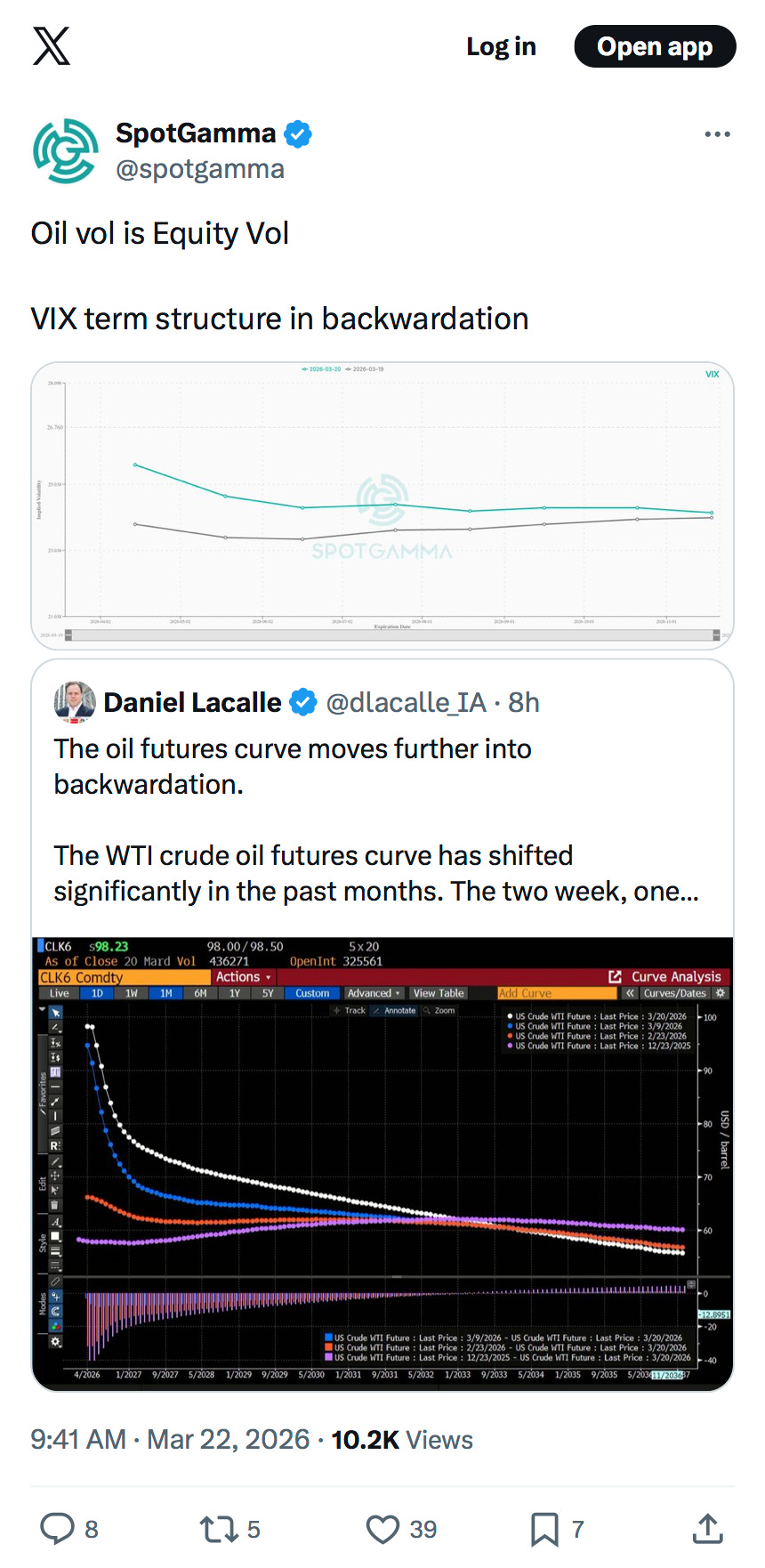
The positioning artifact masks what is happening in the physical market. By early April, Dated Brent, the spot benchmark that measures what refiners actually pay for crude delivered to their terminals, had reached $141.37 per barrel, the highest price since 2008. The gap between the physical price and the futures price had widened to more than $32 per barrel. Rory Johnston, an independent energy analyst whose commodity research service is cited by institutional investors and policy journalists, observed that oil market participants normally discuss term structure spreads in cents, not dollars.
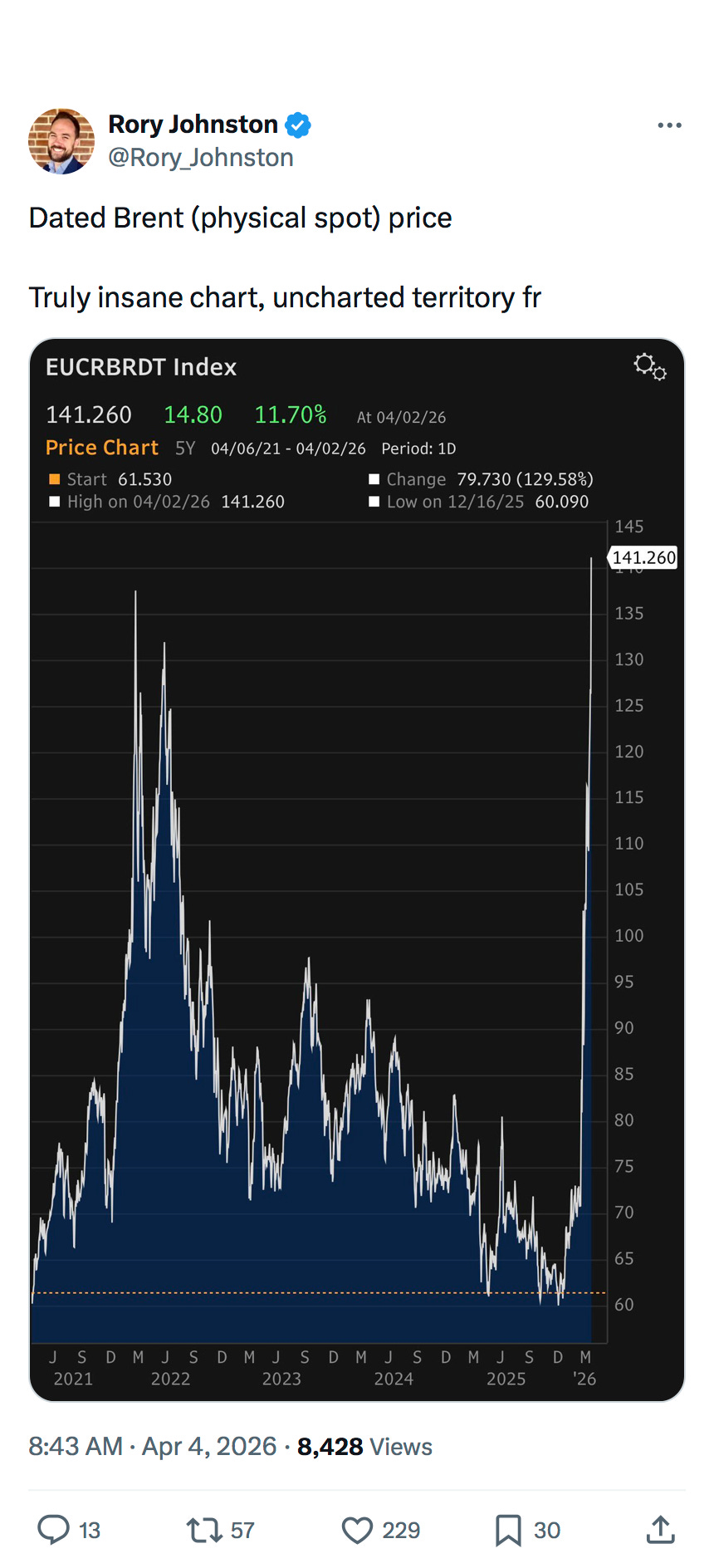
The physical market was screaming. The synthetic market was hedging. The spread between the two is the structural short made visible.
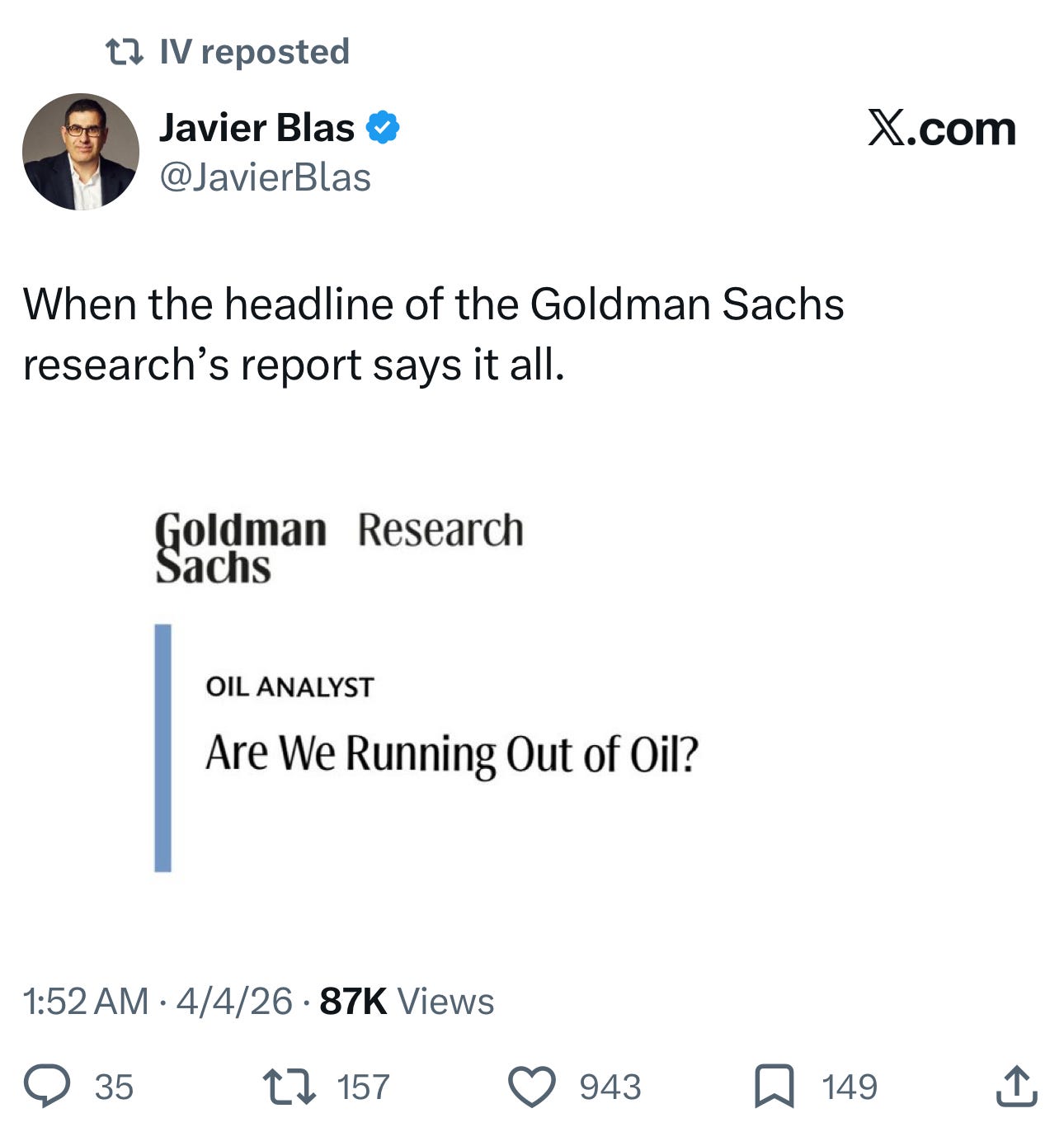
Goldman Sachs published a research note in early April with the title “Are We Running Out of Oil?” The bank’s own data answered the question. The Strait of Hormuz was operating at six percent of normal throughput—a ninety-four percent effective closure of the world’s most critical energy chokepoint.
The inventory consequences were immediate. Global stockpiles had fallen by 162 million barrels, draining at 10.2 million barrels per day. Five weeks of war had erased thirty-seven percent of the inventory builds that took all of 2025 to accumulate. China was adding to strategic reserves while American allies depleted theirs.
But crude is one molecule. The strait’s administration, which Iran operates as a selective-access checkpoint with political screening and fees collected in yuan, does not pass the rest. Liquefied natural gas does not flow: Qatar’s Ras Laffan complex, the largest LNG processing facility on earth, faces a three-to-five-year rebuild after being struck on March 18. Helium does not flow: thirty-three percent of the global supply came from Qatar. Sulfur does not flow: forty-four percent of global seaborne sulfur originates from behind the chokepoint. Fertilizer does not flow: thirty percent of global ammonia production sits behind the strait.
The system is short every molecule. It hedged one of them.
SHORT VOLATILITY
The volatility short is structural, not discretionary. It is embedded in the architecture of the market itself.
Volatility control funds, which manage hundreds of billions of dollars, mechanically reduce equity exposure when volatility rises and increase it when volatility falls. Their selling is not a decision. It is an algorithm. When the VIX spikes, they sell equities regardless of whether the spike reflects a temporary shock or a permanent regime change. These funds don’t decide to sell—they are programmed to. Nomura’s Charlie McElligott, whose cross-asset analysis tracks these mechanical flows, documented the scale: systematic strategies were positioned to shed $52.3 billion in equities under a fifth-percentile volatility shock. The ratchet was firing.
Commodity Trading Advisors, the systematic trend-following funds that manage roughly $400 billion in assets, had built their second-largest short position in five years by early April. Every systematic flow was a seller.
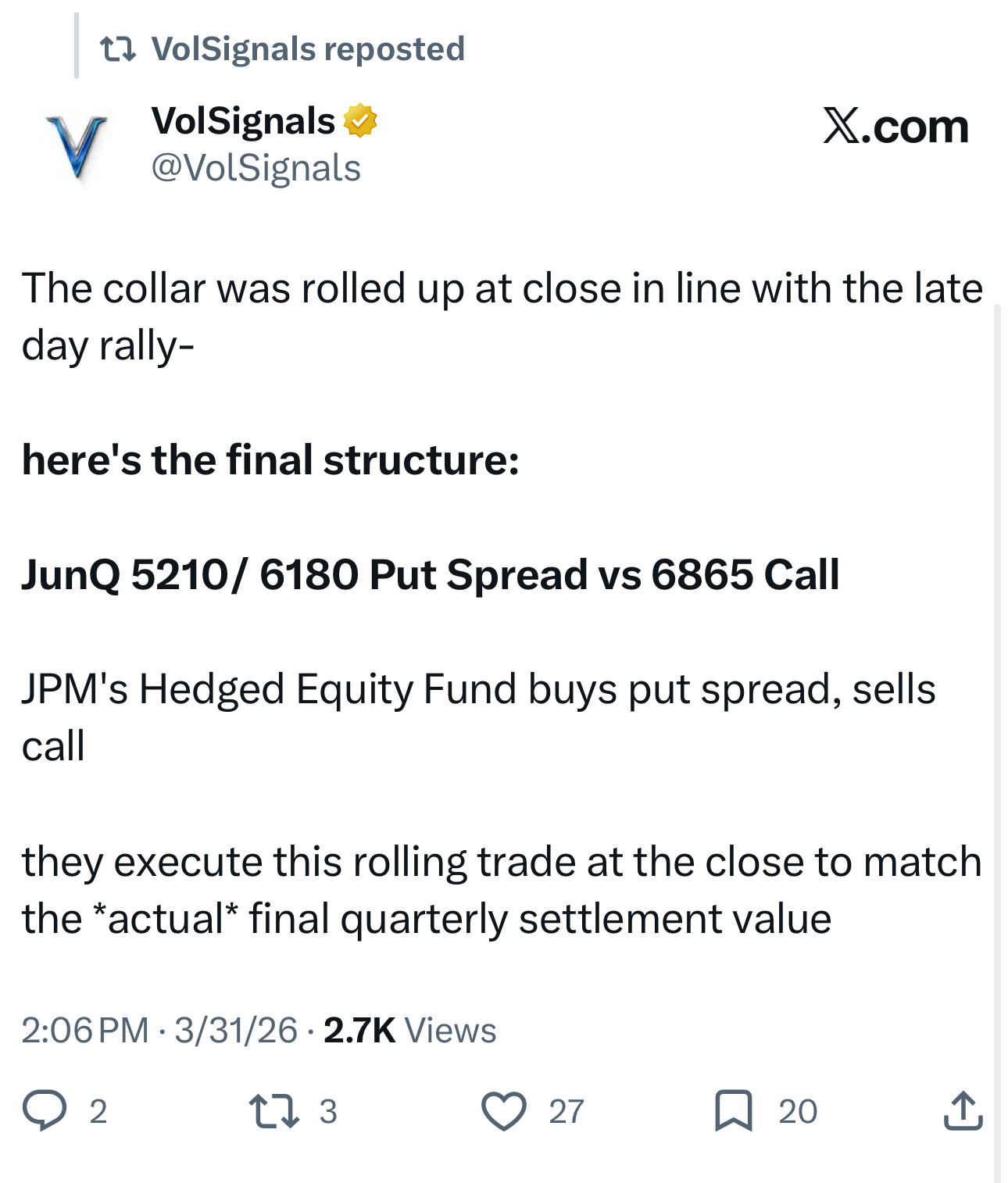
JPMorgan’s quarterly equity hedge, known as the JHEQX collar, told you what the world’s largest bank was buying protection against: a decline of roughly twenty percent in the S&P 500. The structure capped gains above the market’s recent highs and provided a floor—but only to a point. Below that floor, there was no mechanical bid. The gap between the current index level and JPMorgan’s protection contained three hundred forty-eight points of air.
The volatility short is not a bet that nothing will go wrong. It is a mechanical consequence of how the system is built. The funds that suppress volatility do so because their mandates require it. The options structures that cap downside protection do so because their clients demand it. The entire architecture is constructed to absorb small shocks and amplify large ones. The question is never whether the volatility short will be called. The question is what calls it.
A macro trader who publishes under his own name, whose positions are followed by institutional investors, described the kink in the system in a framework that deserves more attention than it has received. The standard options pricing model, Black-Scholes, assumes smooth probability distributions. The toll booth is not smooth. It is a kink: a binary outcome embedded in a system that prices continuous outcomes. The deep out-of-the-money options that the model prices as nearly worthless are the options that pay if the kink materializes. The kink is the toll booth. Deep out-of-the-money is the trade.
SHORT BONDS
The bond short is the most dangerous because bonds are collateral, and collateral is the plumbing that connects everything else.
The United States Treasury market is the foundation of the global financial system. Every repo transaction, every derivative margin call, every central bank reserve portfolio, every insurance company’s statutory capital requirement is built on the assumption that Treasury securities are risk-free. They are not risk-free. They are the most widely held assumption in the history of finance.
The assumption is under simultaneous stress from three directions. Supply is surging: the Treasury must roll approximately $10 trillion in maturing debt through 2026, in addition to financing a deficit that the International Monetary Fund projects will push the national debt to 140 percent of gross domestic product by 2031. Demand is evaporating: Brad Setser, a senior fellow at the Council on Foreign Relations, documented that net foreign official purchases of Treasury securities fell to zero in the fourth quarter of 2025, before the war began. By early 2026, foreign official holdings showed the steepest weekly decline of the year. Quality is degrading: the spread between on-the-run Treasuries, the most recently issued and most liquid, and off-the-run Treasuries, identical securities issued months or years earlier, has been widening. The same bond is worth different amounts depending on when it was issued. This is not a feature of a risk-free asset. It is the signature of a market where liquidity is fragmenting.
The Federal Reserve is trapped. It cannot cut rates without confirming the stagflationary thesis that the war has created: an economy simultaneously facing supply-driven inflation from the energy crisis and demand-driven contraction from the financial tightening. It cannot hold rates without tightening into a supply shock. It cannot raise rates without accelerating the recession that the labor market is already signaling, with the Fed chair himself acknowledging “effectively zero net job creation in the private sector” in early April.
The rate cut that the market is demanding would lower the short end of the yield curve, providing relief to credit card borrowers and auto loan holders. But it would raise the long end on inflation expectations, because cutting rates during a supply-driven energy crisis signals that the central bank has chosen growth over price stability. The thirty-year mortgage rate, which had climbed to 6.46 percent for the fifth consecutive week by early April, would not fall. It would rise. The pipe that is supposed to carry relief splits: cheap short-term funding flows into a system where the long-duration collateral backing everything is losing value. The cut makes the collateral crisis worse.
The thirty-year Treasury auction on April 9 is the next test. If it goes poorly, the market that underwrites the dollar system will have demonstrated, in a single auction, that the demand to hold thirty-year American government debt at current yields is insufficient. The last suppression layer in the bond market is the assumption that someone will always buy the paper. The auction will tell you whether someone will.
• • •
SECTION III
The Synthetic Long
The mirror image of the three shorts is the synthetic long: the system is simultaneously long everything that requires the shorts to hold.
It is long artificial intelligence capital expenditure. The largest technology companies have committed more than $650 billion to building data centers, training models, and deploying inference infrastructure. This buildout requires massive physical inputs: transformers (eighty percent imported from China), copper (forty percent of global supply transits chokepoints now under stress), electricity (generated by natural gas that no longer flows from Qatar), and cooling systems (manufactured with components subject to the tariffs the administration imposed in early April). The elephants of AI capital expenditure must pass through the keyhole of a physical supply chain that the war is closing.
That is the supply chain argument. The military argument is worse.
On April 2, the Islamic Revolutionary Guard Corps attacked an Amazon cloud computing center in Bahrain, ninety-four minutes after a Microsoft executive announced plans for advanced AI models by 2027. The keyhole was not merely narrowing. It was being bombed while the elephants were still announcing their plans to walk through it.
It is long private credit. The market for business development companies, collateralized loan obligations, and direct lending funds has grown to a scale that the Financial Stability Board considers systemically significant. Fitch Ratings described the sector as exhibiting “bubble-like features” while concluding that it was “not systemic.”
That is the same formulation. In 2007, the agencies assessed that subprime mortgage exposure was “contained”—not systemic, not contagious, not a threat to the architecture. The containment thesis held until it didn’t, and when it broke, it took the global financial system with it. The private credit sector is now the same size, carrying the same rating agency assurance, facing a stress test that no one has modeled: a land war in the Middle East.
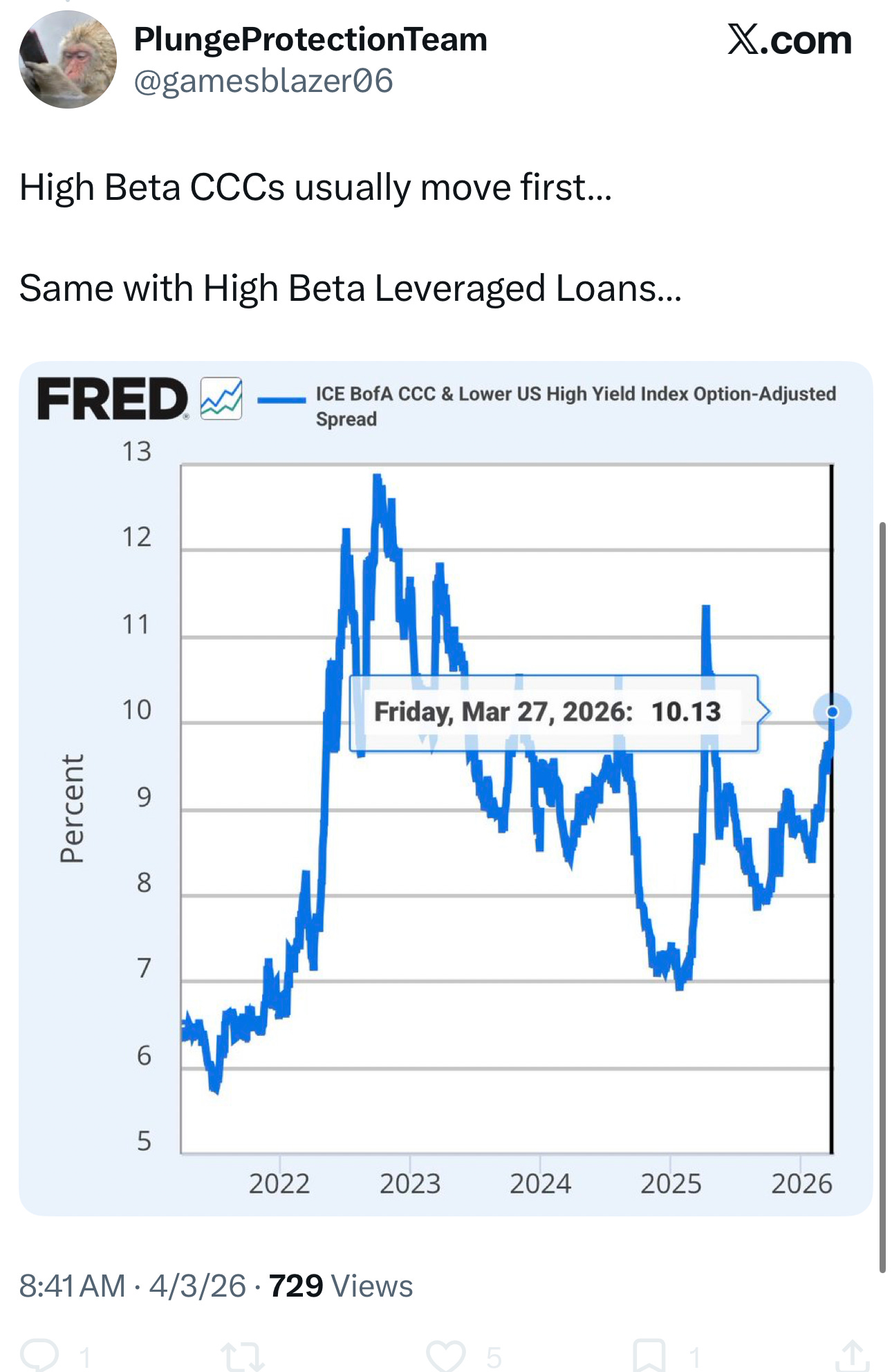
The lowest-quality credit spreads, the CCC-rated bonds at the bottom of the high-yield spectrum, had widened to 10.13 percent by early April, matching their peak during the initial weeks of the pandemic in March 2020. The broader high-yield index, at 3.04 percent, registered the stress as a non-event. The pattern is diagnostic: stress propagates from the bottom of the quality stack upward. The canary is screaming. The mine is open for business.
It is long the assumption that the disruption is temporary. Every borrower, every insurer, every pension fund, every sovereign wealth fund that has not restructured its portfolio for a permanent change in the price of energy is borrowing against a future in which the strait reopens, the molecules flow, and the pre-war equilibrium returns. The short-term borrowing delusion is the most widely held position in the global financial system, and it requires only one condition to unwind: the disruption must persist long enough for the market to stop pricing it as a shock and start pricing it as a regime.
• • •
SECTION IV
The Margin Call
The war did not create these shorts. The shorts were built over decades of falling commodity prices, suppressed volatility, and expanding sovereign debt. The war is the margin call.
A margin call does not care about the narrative. It does not care whether the president says the strait will reopen “automatically” or whether the treasury secretary promises the situation is “short-lived.” It does not care whether shale producers hedge at $80 or whether volatility control funds are mechanically selling. A margin call is arithmetic: the value of the collateral has fallen below the threshold required to maintain the position, and the position must be reduced or the collateral must be replenished.
The global financial system is facing a margin call on all three shorts simultaneously. The commodity short is being squeezed by $141 physical crude against $109 futures. The volatility short is being squeezed by mechanical selling into a market with no mechanical bid. The bond short is being squeezed by supply surging into evaporating demand while quality degrades.
The repricing has not yet arrived in full. An independent macro analyst who decomposes equity returns by driver estimated that thirty percent of the S&P 500’s year-to-date decline could be attributed to geopolitical risk repricing. If thirty percent of the repricing has arrived, seventy percent has not. The sun exploded. The light is still traveling.
The convergent window, the period from April 9 through April 17 when the thirty-year Treasury auction, European crude delivery cessation, American crude delivery cessation, and the Amazon fuel surcharge activation all occur within eight days, is the calendar of the margin call. Each date is a moment when one of the three shorts encounters a physical constraint that the synthetic layer cannot absorb.
The system is short everything real and long everything synthetic. The margin call is the moment when the synthetic layer discovers that the real layer has moved, permanently, and the gap between them must close. The gap closes in one direction only. The synthetic layer reprices to the physical layer. The physical layer does not reprice to the synthetic one.
The molecules do not negotiate.